Why I Built OneTruth Instead of Another Self-Improvement App
A lot of people already know something is off.
They know they are tired in a way sleep does not fix. They know they keep making the same compromises. They know they are drifting away from what they once said mattered. They know they are performing a version of themselves in work, relationships, even in private.
The problem is usually not ignorance.
The problem is that most of us do not want to look at ourselves honestly for more than a few seconds.
I do not say that from some superior position. I say it because I am exactly that kind of person too.
I am not writing this as a therapist, a monk, or a polished founder who already has everything figured out. I am writing it as a normal person trying to build in the middle of real life: too many moving parts, multiple products, multiple constraints, business pressure, unfinished ideas, ambition, doubt, and the constant temptation to confuse motion with direction.
Over the past year, I spent a lot of time thinking about a larger framework called Alivezen.
At its core, it was never meant to be another motivational brand. I wanted to think more seriously about what people often call “manifestation,” because I felt that whole topic had been distorted beyond recognition.
Especially in China, it is often packaged as something loud, mystical, and inflated. Too many people talk about changing your life as if all you need is a prettier vision board and stronger emotions. On the other side, many personality tests turn people into neat little labels that are easy to share but not very useful to live with.
One side floats too high. The other flattens people too quickly.
Neither felt honest to me.
What interested me was something more grounded: how a person actually changes the direction of a life. Not through slogans. Not through spiritual theater. Not through being sorted into a cute category. But through awareness, daily behavior, intention, long-term direction, and some form of real reinforcement.
That was the larger frame.
I even built an internal assessment system around this idea quite a while ago. It was meant to measure something I care a lot about: the distance between what a person wants, what they are actually able to do, and what keeps breaking the link between the two.
But here is the funny part.
That bigger system stayed where many big ideas stay: in drafts, structures, notes, frameworks, unfinished plans.
And then something smaller appeared first.
OneTruth.
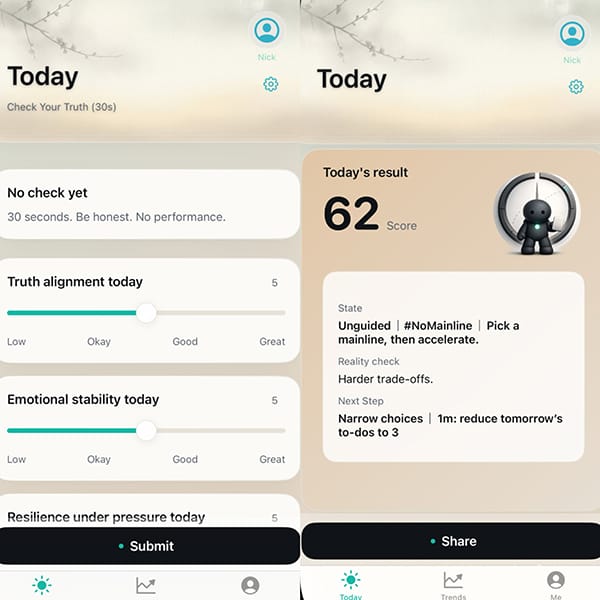
I did not build it because the market needed one more self-improvement app.
I built it because I wanted a tool for myself.
Something simple enough to use every day, but sharp enough that I could not easily lie to myself while using it.
That was the real starting point.
Not scale. Not brand strategy. Not “the market opportunity.”
Just a very practical question: what would help me tell the truth to myself, briefly but consistently, without turning it into a ritual of self-judgment?
That last part matters.
Because many growth products end up becoming little machines that repeat the same message in different outfits: you are still not enough today.
They call it discipline, tracking, optimization, reflection, accountability. Sometimes it is useful. Often it slowly turns into a digital schoolteacher living in your pocket.
Always checking. Always correcting. Always disappointed.
That is not what I wanted.
I did not want another app that makes people feel guilty in a more well-designed way.
I wanted something closer to a mirror.
A mirror does not flatter you. But it does not lecture you either.
It simply shows you where you are.
That is the spirit behind OneTruth.
Not performance. Not inspiration porn. Not moral pressure.
Just one honest check-in a day.
A brief internal calibration.
Not to ask, “How can I become a perfect person?”
But to ask, “What is actually true about me today?”
That question sounds small. It is not.
Because a lot of personal suffering comes from the gap between reality and self-narrative. We say we care about one thing and keep serving another. We say we are waiting for the right timing when in fact we are avoiding discomfort. We say we are overwhelmed when sometimes we are just scattered. We say we want transformation when what we really want is relief.
A daily honest check does not solve everything.
But it does something more important: it reduces self-deception.
And once self-deception drops, even a little, better decisions become more possible.
That is also why OneTruth is not just “reflection.” It has to point to a next move.
A mirror alone is not enough.
If all an app does is tell you that you are misaligned, tired, avoidant, restless, or numb, then congratulations, now you are more accurately miserable.
Useful tools should do better than that.
So OneTruth is designed to do three things in a very compact way:
See clearly. Calibrate gently. Move one step.
That is it.
No theatrical healing. No grand identity rewrite. No fake certainty.
Just enough truth to interrupt drift.
And that, to me, is where real change starts.
Not in one dramatic breakthrough, but in repeated moments of non-performance.
A person admits what is true. Makes one better move. Repeats.
Over time, that changes trajectory.
This matters to me far beyond one app.
Because I do not think life is mainly shaped by big declarations. I think it is shaped by what we repeat when nobody is watching.
That is true in business too.
Right now, I am building across two realities at once. One is the set of products I am trying to build under my own direction. The other is the AI-related work and products I am building with partners in the middle of actual constraints and real-world complexity.
So I do not have the luxury of pretending that life is clean, linear, and fully controlled.
It is not.
That is exactly why honesty matters more.
If your life is messy, your internal signal needs to be cleaner, not louder.
And that is why I made OneTruth first.
Not because it is the final form of what I want to build.
But because it solves a problem I believe is deeper than most productivity problems: people drift because they stop telling themselves the truth.
Sometimes softly. Sometimes strategically. Sometimes almost elegantly.
But still.
They drift.
If OneTruth can help a person pause for thirty seconds at night and see themselves a little more clearly, without shame and without performance, I think that matters.
If it can help someone stop acting out growth and start practicing honesty, I think that matters even more.
And yes, I hope it becomes a real business.
I am not allergic to ambition. I am not pretending money is irrelevant. Wealth matters. Freedom matters. Building something durable matters.
But I also think the best products usually carry a real human need inside them. Not a pitch deck version of need. A lived one.
OneTruth came from that place.
I built it first for myself.
Now I am releasing it to see whether it can be useful to other people too.
That is the experiment.
Not whether people enjoy being analyzed.
But whether they are ready, even briefly, to stop performing and face one true thing.